The Loretto Chapel Staircase (The Miraculous Staircase): Story, Mystery & Facts
Walk into the Loretto Chapel in Santa Fe and watch what people do first: they look up. The staircase spiralling to the choir loft makes two full turns, climbs about twenty feet, and has nothing down the middle holding it up — no central pole, no obvious support. That one detail is why it has been called miraculous for over a century, and why a wood scientist, a structural skeptic, and a Santa Fe historian have each spent real time on it. This is the complete field guide: what the staircase is, why it’s called miraculous, and an honest accounting of which parts of the story hold up.
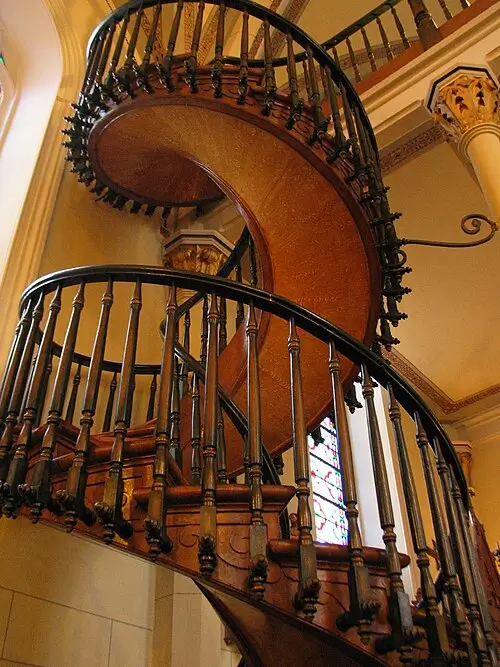
What is the Loretto Chapel staircase?
It is a helix-shaped spiral staircase that rises roughly 20 feet (sources vary, about 20–22 ft) to the choir loft of the former Loretto Chapel in Santa Fe, New Mexico. It makes two complete 360° turns, has 33 steps, and famously uses no central newel pole — the column a conventional spiral staircase leans on. The chapel, consecrated in 1878, is now a private museum and wedding venue and is listed on the National Register of Historic Places (#73001150).
Master spec table
| Common name | The Miraculous Staircase (Loretto Staircase) |
|---|---|
| Location | Loretto Chapel, 207 Old Santa Fe Trail, Santa Fe, New Mexico (now a private museum & wedding chapel) |
| Shape | Helix (true spiral), two complete 360° turns |
| Steps | 33 |
| Height | ~20 ft to the choir loft (sources give 20–22 ft) |
| Central support | No central newel pole; load carried by the two helical stringers into floor and loft |
| Stringer segments | Inner stringer 7 segments; outer stringer 9 segments (per Wikipedia) |
| Fasteners | Wooden pegs; no iron nails. Whether wood glue also forms a laminate is contested — see how it works |
| Wood | Spruce (genus Picea); a 1990s study proposed a unique “Loretto Spruce” — contested, see wood type |
| Builder | Unknown by legend; historian Mary Jean Straw Cook identifies François-Jean “Frenchy” Rochas as the probable carpenter — see who built it |
| Chapel architect | Projectus Mouly (the chapel itself, not the stair) |
| Built | Chapel consecrated 1878; staircase added shortly after |
| Designation | National Register of Historic Places #73001150 |
Why is it called “miraculous”?
When the chapel was completed in 1878, the Sisters of Loretto found there was no way to reach the new choir loft — the architect, Projectus Mouly, had died, and a conventional staircase would have consumed too much of the small chapel. By tradition, the sisters prayed a nine-day novena to St. Joseph, the patron saint of carpenters. On the final day a stranger appeared with a donkey and a few simple tools, built the elegant spiral stair over the following months, and left — so the story goes — without taking payment or giving his name. Many came to believe the carpenter was St. Joseph himself. The fuller faith tradition is covered on the St. Joseph legend page.
The three mysteries
Nearly everything written about the staircase comes down to three questions. Here’s the one-line answer to each, with a link to the full treatment.
How does it stand up? The load travels through two helical stringers — the inner one curls so tightly it acts almost like a hidden pole. → How the staircase works
Who built it? Unknown by legend; the leading historical candidate is French carpenter “Frenchy” Rochas. → Who built the staircase
What is the wood? Spruce (genus Picea); one researcher argued it matches no known spruce on Earth. → What wood is it made of
Is it really unexplained?
Honestly — the “defies physics” framing does not survive scrutiny, and we’d rather tell you that than sell you a myth.
Engineers can explain how a center-pole-free spiral stands, skeptics have identified a tightly-curved inner stringer plus an iron bracket added later, and the carpenter’s identity was probably known to Santa Feans of the 1890s.
What remains genuinely striking is the craftsmanship: a flawless wooden double-helix built with hand tools by someone who then disappeared from the record. We lay out every claim against the evidence — the believers’ and the skeptics’ — on the debunked-or-miracle page.
Quick facts
- 33 steps, two full 360° turns, ~20 ft to the choir loft.
- No central pole — the defining structural feature.
- Wooden pegs, no nails.
- Built c.1878–1881 for the Sisters of Loretto.
- Wood is spruce (genus Picea); “extinct/unique species” is a contested claim.
- Probable builder: François-Jean “Frenchy” Rochas (per historian M. J. Straw Cook).
- On the National Register of Historic Places (#73001150).
Explore the full cluster
- How the staircase works — the engineering explained
- Who built the Loretto staircase?
- What wood is it made of?
- The hidden iron bracket that reinforced it
- The French carpentry method behind the helix
- Debunked or miracle? Every claim vs the evidence
- The St. Joseph legend
- ‘Loretto Spruce’: the tree that may not exist
- The lost twin: Rochas’s St. Vincent staircase
- Could you build it today?
- The 1998 film vs the Netflix “Staircase”
- Staircases like Loretto’s: what actually compares
- Plan your visit: hours, tickets & what to expect
More on the chapel & your visit
- The St. Joseph novena: the nine-day prayer behind the staircase
- The staircase on screen & in print: TV, film & books
- Where to stay near the Loretto Chapel
Researched & fact-checked by the Loretto Volunteers Editorial Team
Loretto Volunteers is an independent research project documenting the history, architecture, and enduring mystery of the Loretto Chapel staircase. We work from primary and archival sources and show our evidence. Last reviewed: June 2026.